Start in the walk-in, not the dashboard
David Cantu describes going to sleep thinking about restaurant workflows: a manager in a cooler, someone driving to work, the manual tasks waiting before service begins. It is an unusually specific starting point for a conversation about AI. It is also a useful one. Software has to earn its place in those moments.
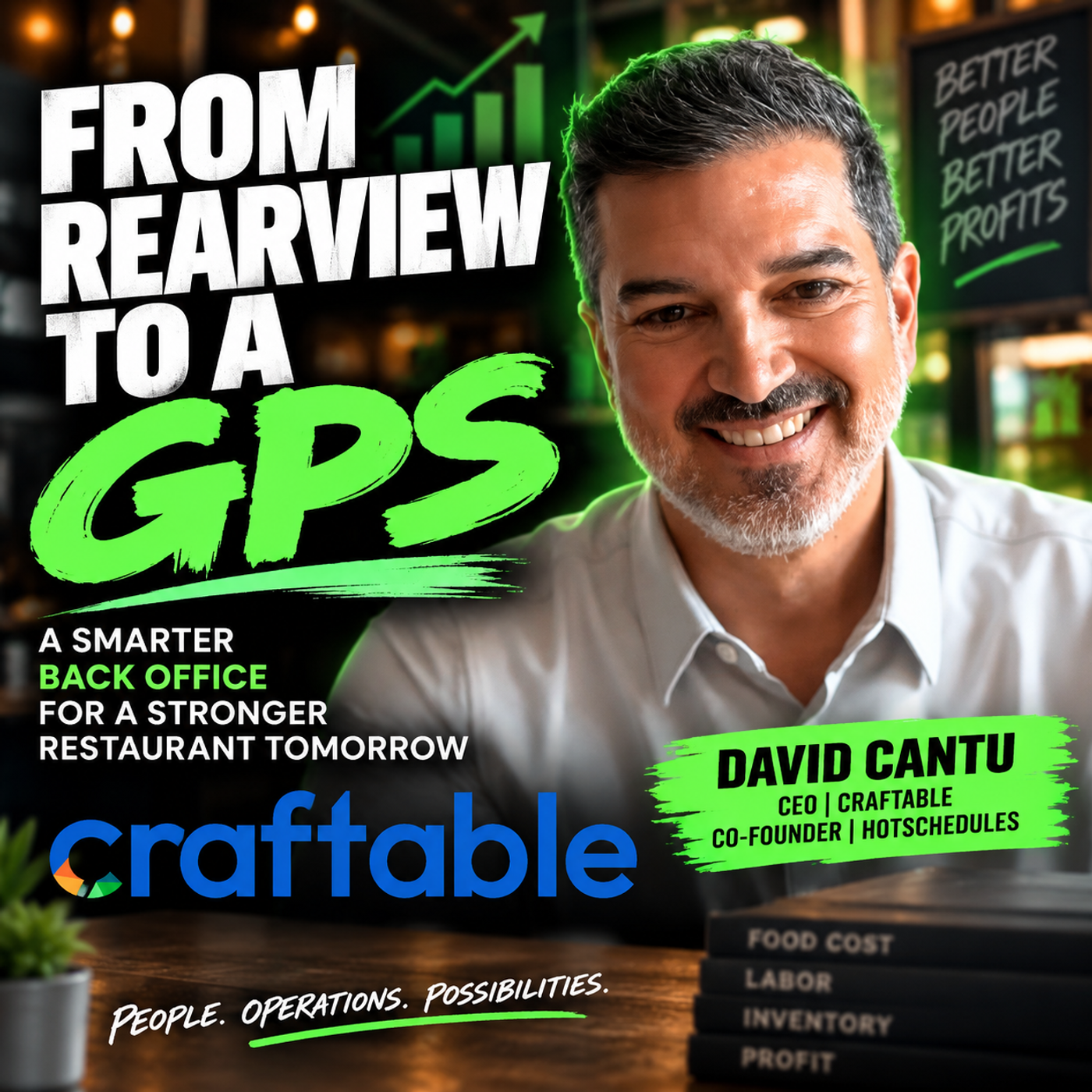
On ChatGTM, the Craftable CEO and HotSchedules co-founder talks with Michael Beck and Chad Horn about rebuilding technology around the operator. The discussion follows their meeting at Prosper Forum, where leadership, learning and the relationship between people and restaurant margins had come into focus.
Cantu's concern is the administrative burden that pulls managers away from developing employees and looking after guests. He recalls an earlier operating experience in which administrative support helped keep that focus possible. Today, he sees managers carrying manual work that executives may not fully appreciate. A product demonstration can look efficient while the person using it still spends the evening entering information.
A rollout needs owners before it needs applause
Cantu treats implementation as shared work with explicit responsibilities. The restaurant company and the technology provider both need accountable people. He describes executive sponsors on each side and an agreed process for addressing missed milestones. Expectations should be understood before the contract is signed.
That approach recognizes why operators hesitate to replace back-office systems. A previous implementation may have consumed time without producing the expected benefit. Asking the same team to undertake another one requires more than enthusiasm about a newer product. It requires a credible explanation of who will do the work and how success will be assessed.
The economic buyer also needs to connect the purchase to the people expected to use it. A directive to improve food cost does not explain every daily task to the manager counting inventory. Cantu emphasizes frontline understanding, discipline and incentives. Clean information depends on repeated behaviors, and those behaviors are easier to sustain when people understand their purpose.
For a team preparing a rollout, a practical exercise is to list the new recurring tasks alongside the tasks being removed. Assign an owner to each. If the second list is empty, examine whether the project is actually reducing work or simply adding another place to report it.
Give managers a business they can understand
Cantu wants managers emotionally connected to the business's financial health. In the conversation, he questions the assumption that the highest-sales restaurant is automatically the best-run one. Strong sales can conceal waste. A less prominent location may operate with better discipline and healthier margins.
He also describes the danger of narrow incentives. If people are rewarded for making one reported percentage look right, they may optimize the report. The larger aim is a healthy business supported by good operating practices, customer experience and employee experience. Those relationships need to be explained, not left as separate dashboard tiles.
His examples bring the discussion back to physical work. Portion control and pour tests create opportunities to understand loss. Focusing on the items that matter most can make an improvement effort manageable. The manager needs to connect the number on the screen with a behavior that can be observed and changed during a shift.
The same logic extends to recurring expenses. Beck highlights utilities and other bills that can become familiar enough to escape attention. A change in usage is a reason to investigate. It might lead to a question about equipment, a process or a leak. The number is the beginning of the inquiry; the operating team still has to establish what happened.
Useful intelligence can admit when it is wrong
Cantu's description of better restaurant intelligence includes a feedback loop. When a manager's judgment and a model's recommendation differ, there are at least two possibilities: the manager has missed something, or the model lacks relevant context. He describes engineers investigating those differences rather than treating every disagreement as resistance.
A location has its own circumstances. Staff tenure, nearby competition and changes in the market can affect performance. A recommendation becomes more useful when the system can learn from those conditions and the operator can explain them. Confidence in software should leave room for that conversation.
He is skeptical of AI claims that stop at the label. Data origin, quality, integrations and delivery to the frontline all shape whether an output is useful. The episode presents his vision for Craftable's direction and the work involved; it does not establish that every promised capability will produce the same result in every restaurant.
For buyers, the practical question is what decision becomes clearer. Ask to follow one recommendation from its source data to the action a manager would take, including what happens when the recommendation is wrong. That is a more demanding demonstration than asking whether the platform contains AI.
Judge the tool by the work it makes possible
Cantu links his product perspective to a broader view of leadership. Decisions affect employees, customers and investors, and he describes trying to balance those responsibilities. He advises against pursuing a title for its own sake. The satisfaction he returns to is whether the work helped the people on the other side.
That gives the technology discussion a practical ending. A back-office system should help a manager understand the business, act with better information and spend more useful time with the team. Adoption, accurate inputs and clear accountability remain part of the job. A new interface cannot supply them by itself.
The manager in the walk-in is still the right person to consult. Ask what became easier, what they now understand and which part of the day they got back. Their answer will tell you more than the acronym on the booth.