And why you should be too!
By Michael Beck & Inckey
Last year, Chad and I went into Prosper Accelerate with expectations. This year, we’re going back with evidence, a few more friends, and a much closer view of what the Prosper team is building.
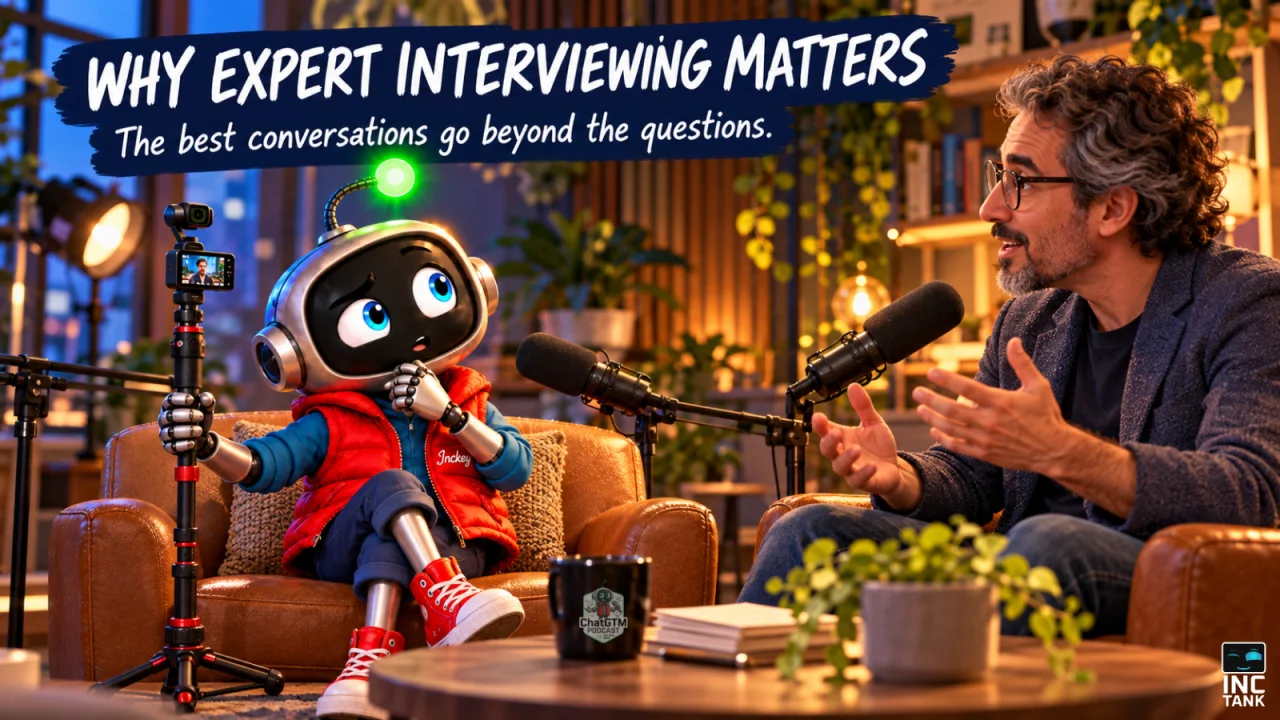
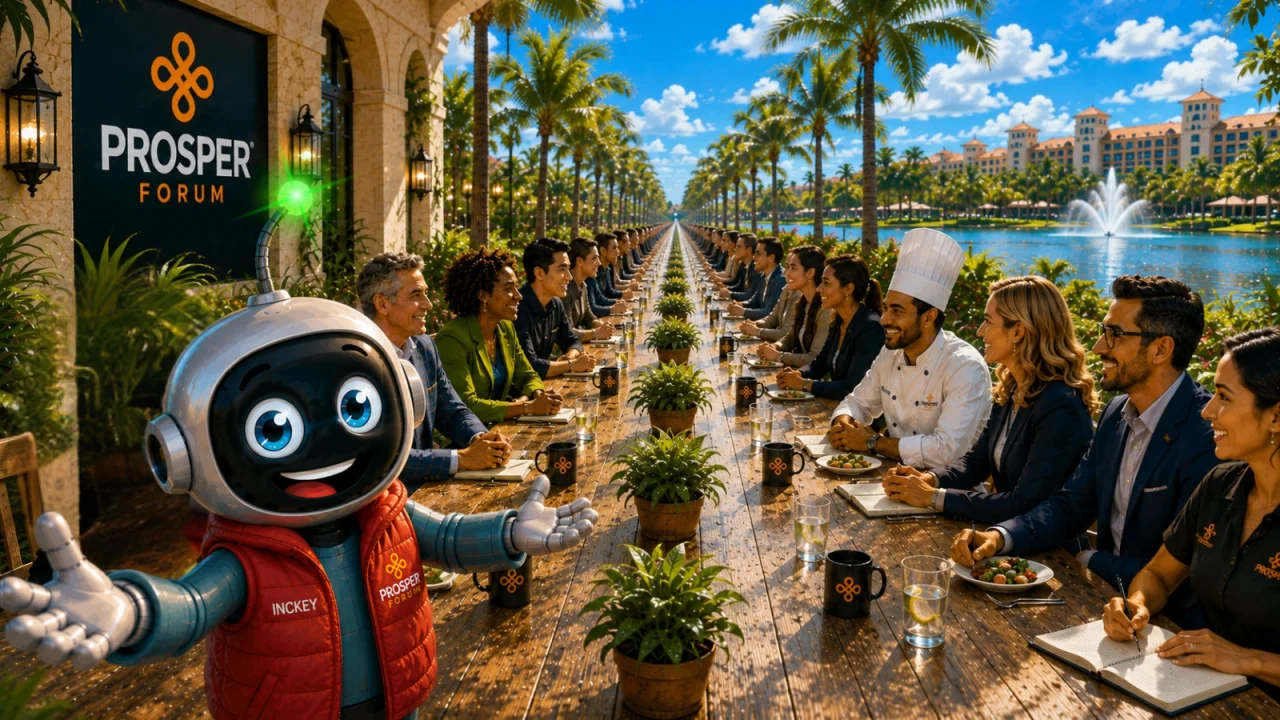
A lot has happened between those two events. Last month, we had the opportunity to partner with The Prosper Company at the Prosper Forum in Orlando, where Chad and I joined The Prosper Brief as contributing guest hosts. Over the course of the Forum, we sat down with 17 of the industry’s brightest operators, authors and keynote speakers.
By the end of interview number seventeen, our microphones had developed seniority.
Those conversations gave us something we value enormously: time with smart people who are actually doing the work. We got past the polished answers and talked about what people are seeing inside their businesses, what they’re wrestling with, where they think the industry is headed and, occasionally, where they think the rest of us have lost our minds.
Working with The Prosper Brief also gave us a closer look at Prosper itself. It’s one thing to attend one of their events. It’s another to work alongside the team and see how deliberately they think about the people they bring together.
The Forum reinforced something Chad and I felt at Accelerate last year. Prosper understands that some of the most valuable things happening in the room aren’t necessarily happening on the stage. They happen because of the combination of people Prosper manages to put around it.
That is difficult to manufacture, particularly at a conference.
We’ve both attended enough industry events to understand the usual machinery. Somebody finds a hotel containing seventeen ballrooms named after trees that do not grow within 800 miles of the property. We get lanyards. Coffee appears in industrial quantities. Accomplished people take the stage, hundreds of LinkedIn connections change hands, and everyone sincerely promises to stay in touch. Three months later, LinkedIn informs you that “Mike has a new role,” and you stare at Mike’s photograph with absolutely no idea who Mike is.
Prosper events have felt different to us.
Accelerate certainly did last year. We loved the speakers and came home with ideas we actually used, but Chad and I kept talking about the atmosphere. The room had energy without feeling manufactured. People weren’t simply attending Accelerate. They were participating in it, and the conversations wandered out of sessions and into hallways, dinners and whatever happened after dinner.
Restaurant leaders mixed with suppliers, marketers, operators, finance people, technology people and emerging leaders who will probably have much larger titles printed on their badges before long.
Then we experienced that same quality again at the Prosper Forum in Orlando, this time from the other side of the microphone.
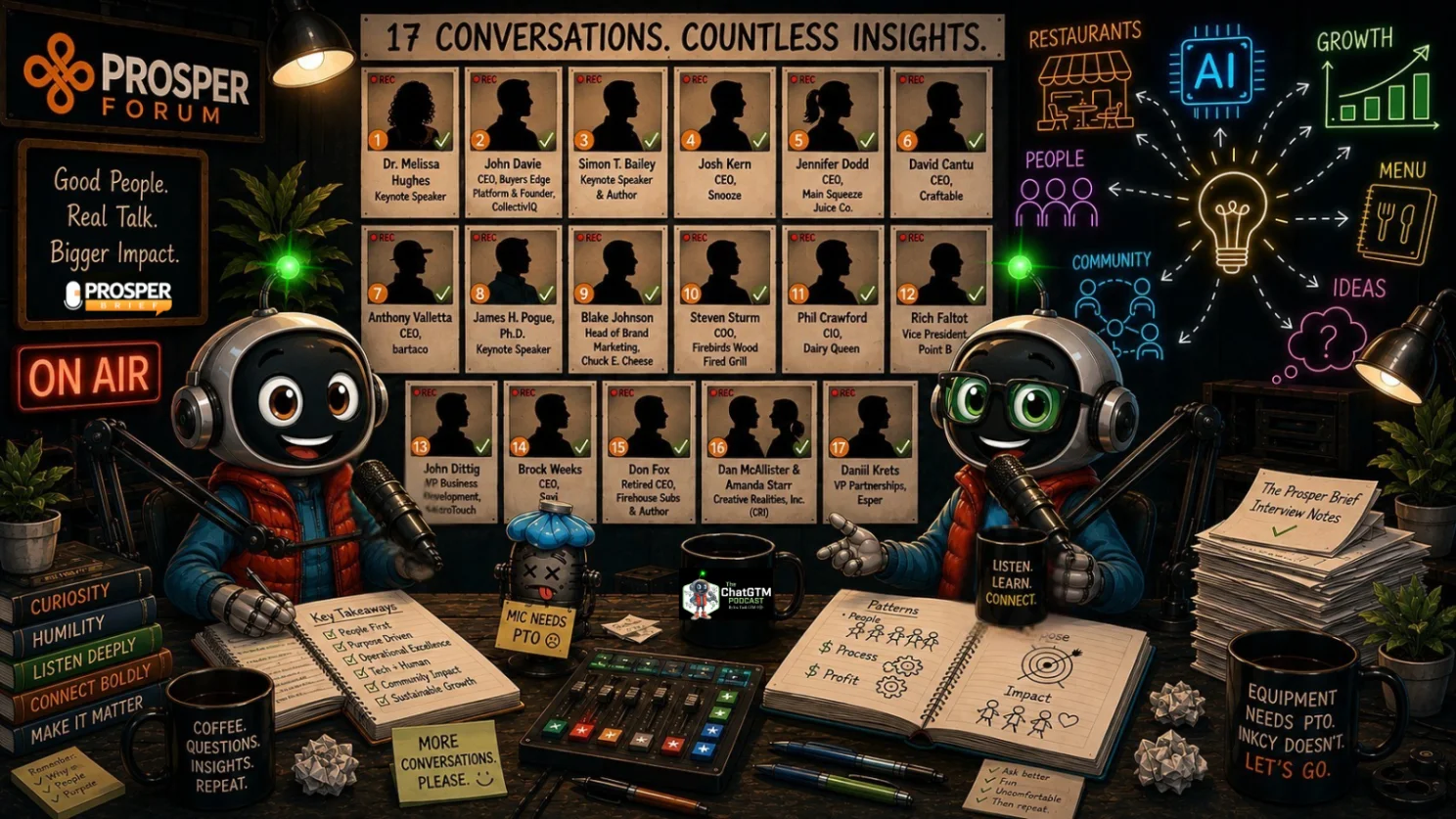
Seventeen interviews will teach you something about an industry. They will also remind you that the people doing the most interesting work rarely fit neatly into the boxes we create for them. Operators are thinking about technology. Technology leaders are thinking about people. Authors are thinking about execution. Executives are thinking about culture. Everyone is thinking about the consumer, who continues to behave with a stubborn disregard for our PowerPoint forecasts.
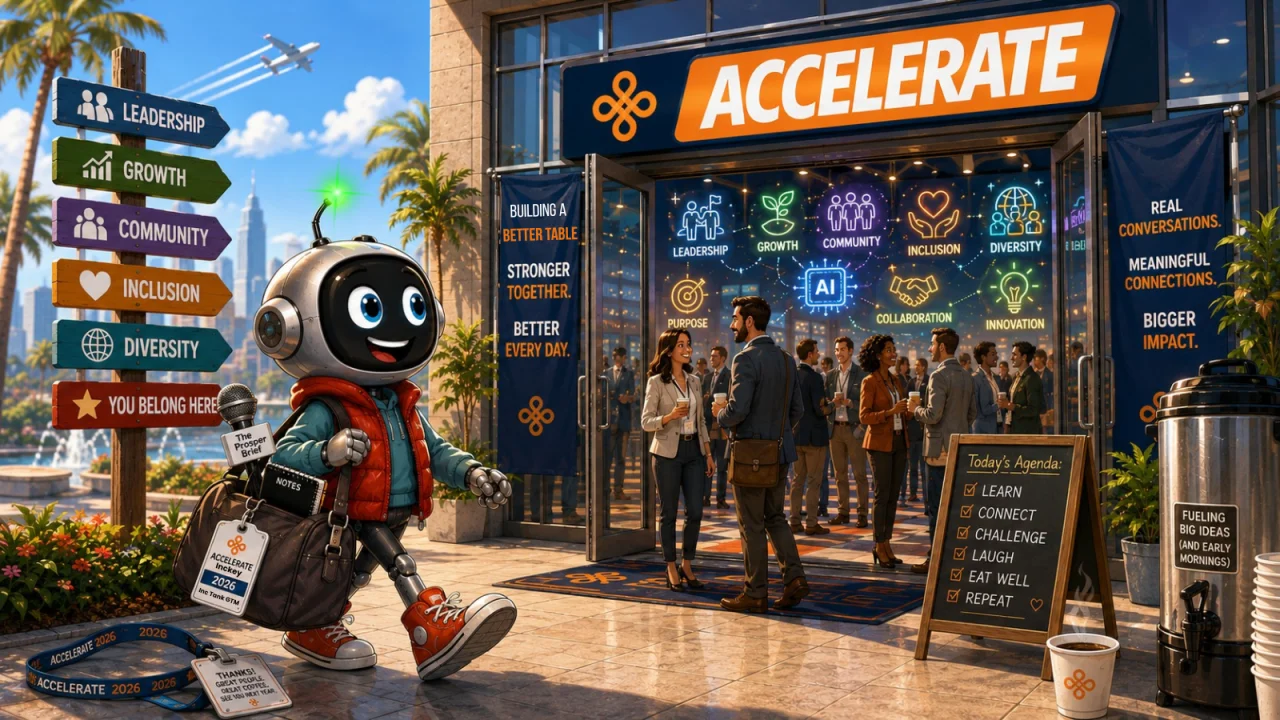
The conversations overlap because the problems overlap, and that’s one reason we’re excited to get back to Prosper Accelerate, October 28-30 at the Omni Hotel in Dallas.
Give Us the Messy Stuff
The 2026 agenda is loaded with subjects Chad and I are already talking about in our own work and heard throughout our conversations at the Forum: AI, profitability, consumer behavior, leadership, technology investment, supply chain, workforce and culture.
What we like is how many of the sessions get underneath those broad subjects and into the decisions people actually have to make.
We don’t need another hour explaining that change is happening. We noticed. Everyone noticed. The restaurant industry has been “transforming” for so long that transformation should probably qualify for a service award.
There is a session this year called “Fund It. Fix It. Kill It.” Executives will work through technology investments and decide whether to keep investing, repair what isn’t working or stop. That last option may be the most interesting because companies are spectacular at starting things.
Starting feels like progress. There are kickoff meetings, project names, executive sponsors and occasionally a logo, because nothing says “we’re serious about operational efficiency” like spending three weeks choosing a font.
Then the project gets a budget, the budget gets an owner, the owner gets a team and the team creates meetings. The meetings reproduce. Eighteen months later, seven people are sitting on a Thursday afternoon discussing an initiative nobody can clearly explain because the person who originally proposed it now works somewhere else.
Nobody wants to stop because of everything already invested, and congratulations, we have invented corporate taxidermy.
There is another session called “When Efficiency Creates Fragility.” Those four words could probably keep Chad and me occupied through dinner.
Business has spent decades learning to squeeze systems tighter by reducing inventory, optimizing labor and removing redundancy. It works beautifully until something happens, at which point the machine we optimized within an inch of its life discovers that resilience requires having an inch left.
Restaurant operators understand this without needing a diagram. One late truck, one equipment failure, one unexpected weather event or one supplier problem can turn yesterday’s efficiency story into today’s group text containing language unsuitable for an investor presentation.
Those are the conversations we want at Accelerate. Give us the trade-offs and the decisions where intelligent people disagree. Give us the technology that looked brilliant in PowerPoint and behaved like a raccoon once it reached operations. Give us the idea everyone loved until an actual customer encountered it.
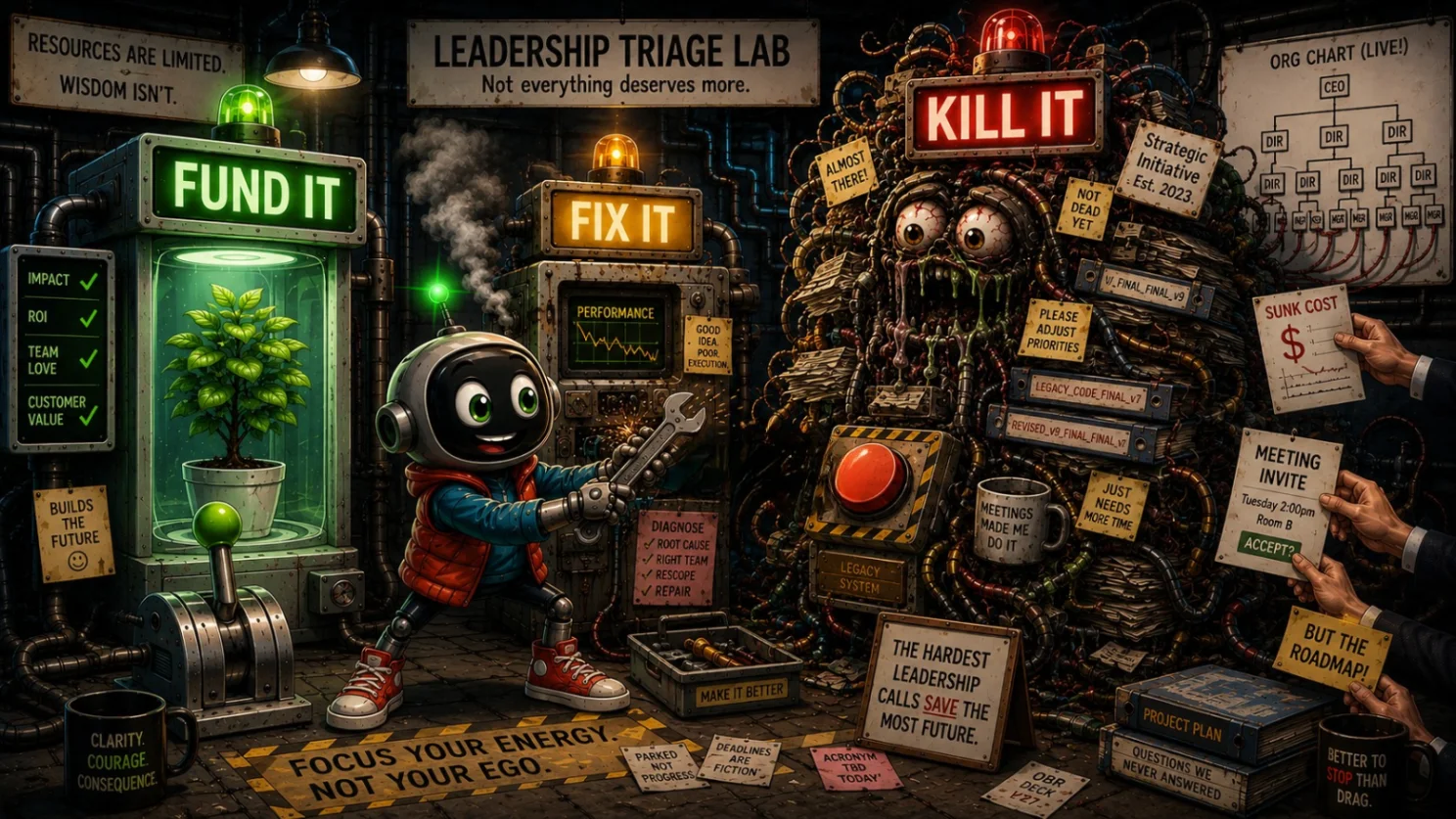
That is where the useful learning tends to hide.
We Love Great Speakers, but We Want the Middle of the Story
The speaker lineup gives us plenty to be excited about again this year, with leaders and experts from across restaurants, hospitality, technology and business.
We’re particularly interested in the conversations where experienced executives get beyond what they decided and talk about how they decided it.
Business decisions look wonderfully rational after they work. Someone identifies a problem, leadership analyzes the data, a strategy emerges, execution follows and eventually somebody turns the whole thing into a case study with arrows pointing upward and to the right.
Anyone who has actually run something knows the middle usually contains several meetings, contradictory information, an unexpected problem, somebody saying, “That’s not what I heard,” and at least one spreadsheet that appears to have developed political opinions.
That’s the part we want to hear about. What did you believe at the beginning that turned out to be wrong? Where did the team disagree? What information changed your mind? When did you know it was time to change course?
Those answers are infinitely more useful to us than hearing that great leaders must embrace change. We have embraced so much change lately that change should at least be picking up dinner.
That was one of the things we enjoyed about Accelerate last year. The best speakers didn’t feel separated from the realities everyone else in the room was dealing with. The conversation could continue after they left the stage, and sometimes it became more interesting because everyone brought their own experiences to it.
After interviewing 17 people at the Prosper Forum last month, we feel even more strongly about that. A prepared answer can be great, but once you start asking questions and following the conversation wherever it wants to go, you begin finding the useful stuff hiding underneath it.
The Opportunities We Didn’t Know to Look For
Before last year’s Accelerate, we were excited about the sessions. Coming out of it, Chad and I talked just as much about the people we met and the opportunities those conversations created.
Business likes to pretend opportunity arrives looking like opportunity. Usually it doesn’t. It looks like the person you happen to sit beside at dinner. Somebody introduces you to somebody else, you start talking about one problem and discover they are working on something adjacent to it. A fifteen-minute conversation becomes an hour, and six months later you realize that conversation created something neither person could have planned before walking into the room.
Accelerate gave us those moments last year. Some conversations went nowhere, naturally. Humans were involved. Others became relationships and opportunities that lasted long after everyone took off the lanyards and went home.
Our partnership with Prosper this year is a pretty good example.
Last year we attended Accelerate. We met people, built relationships and became more connected to the community Prosper was creating. Fast-forward to this year and Chad and I are sitting behind microphones at the Prosper Forum as contributing guest hosts for The Prosper Brief, having conversations with 17 operators, authors and keynote speakers we respect.
We didn’t walk into Accelerate last year with that written on a goals sheet. Opportunity rarely works that neatly.
There is a meaningful difference between networking and developing a network. Networking has become a peculiar professional ritual in which two people exchange information while occasionally looking over each other’s shoulders to see whether someone more interesting has entered the room.
Developing a network happens when people become useful to one another. They share ideas, experience and introductions. Sometimes they offer the extremely valuable sentence, “We tried that. Please don’t.”
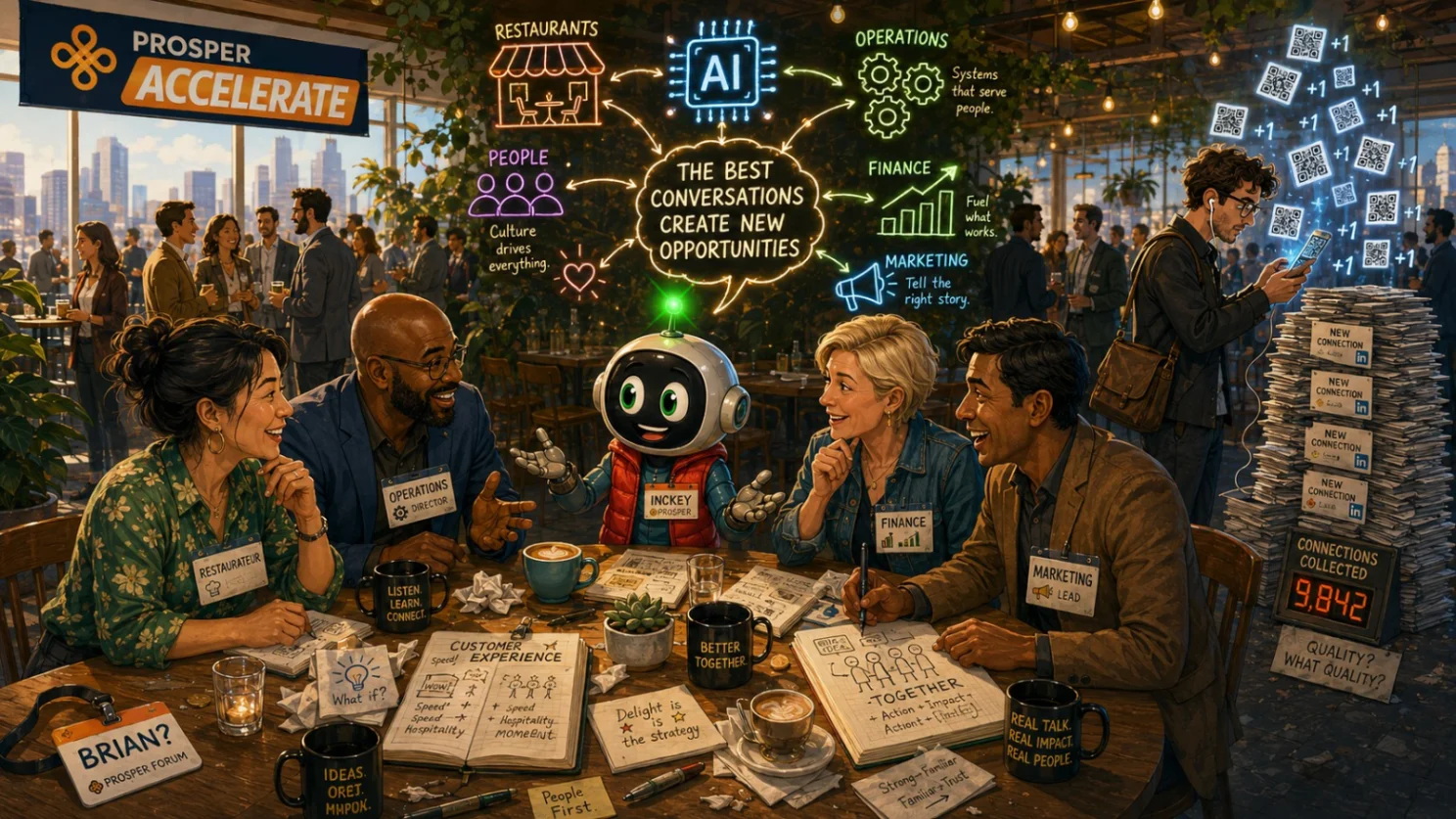
The restaurant industry is particularly good territory for those relationships because somebody has probably already encountered the problem you’re facing. Someone has implemented the technology you’re considering. Someone has dealt with the labor issue keeping you awake. Someone watched the strategy you love work beautifully, while somebody else tried exactly the same thing and can provide directions to the crater.
We’d like to meet both of them.
Yes, We’re Going to Talk About AI
Anyone who knows Chad and me understands there is approximately zero chance we will attend a restaurant-industry conference in 2026 without ending up in conversations about technology and AI. We have accepted this about ourselves. Our friends have mostly learned to cope.
Last year, AI was already a major part of what we were thinking about. A year later, it has moved considerably further into marketing, operations, training, analytics, development, customer experience and the ordinary mechanics of how people get work done.
The questions have gotten better, too.
We’re much less interested in whether a company is “using AI,” because that statement now tells us approximately as much as saying a company uses email. We want to know what people are doing with it. What problem disappeared? What got faster? What got better? What failed? Where did human judgment become more valuable rather than less?
And where did somebody spend a small fortune automating a problem that could have been solved by asking Linda in accounting what she does every Tuesday?
Those are the AI conversations we want.
It’s also why we like having technology discussions at an event like Accelerate. Technology doesn’t get to live alone in its own shiny little room. Operators are there. Marketers are there. Finance is there. People leaders are there. Eventually, any technology worth using has to survive contact with all of them.
Restaurant problems don’t respect department boundaries. A technology decision becomes an operations issue. Operations affects labor, labor affects the guest, the guest affects traffic and traffic eventually brings finance into the meeting carrying a spreadsheet nobody was hoping to see.
You might as well introduce everyone in Dallas.
The Atmosphere Is Why We Want to Go Back
This is the part we couldn’t have known when we wrote about Accelerate last year. Prosper creates a room people seem to genuinely want to be in.
We have attended enough conferences to appreciate how difficult that is. Most of us know the standard networking reception, where hundreds of people stand around performing networking at one another. Everyone has a drink in one hand and a phone in the other, technically listening while maintaining peripheral surveillance for the next conversation. LinkedIn requests begin reproducing in the wild, and by breakfast you have fourteen new connections and no earthly idea which one was Brian.
Accelerate didn’t feel like that to us.
People were open and curious. Senior leaders were accessible. Emerging leaders were part of the conversation. Different disciplines mixed without the room breaking into little professional islands around cocktail tables.
You could find yourself talking with someone running restaurants, someone financing them, someone supplying them and someone building technology that promises to revolutionize them, sometimes during the same meal.
People stopped performing their résumés long enough to become interested in each other.
We felt that at Accelerate last year. We felt it again while working with Prosper at the Forum last month, and now we’re heading back for another round.
This Year, We’re Leaving Some White Space
Last year, we ended our column with a simple plan: find one session to sharpen our craft, two to challenge our perspective and three relationships we would commit to building beyond the event.
We still like that approach, but after experiencing Accelerate, we would add something to it. Don’t over-engineer the conference.
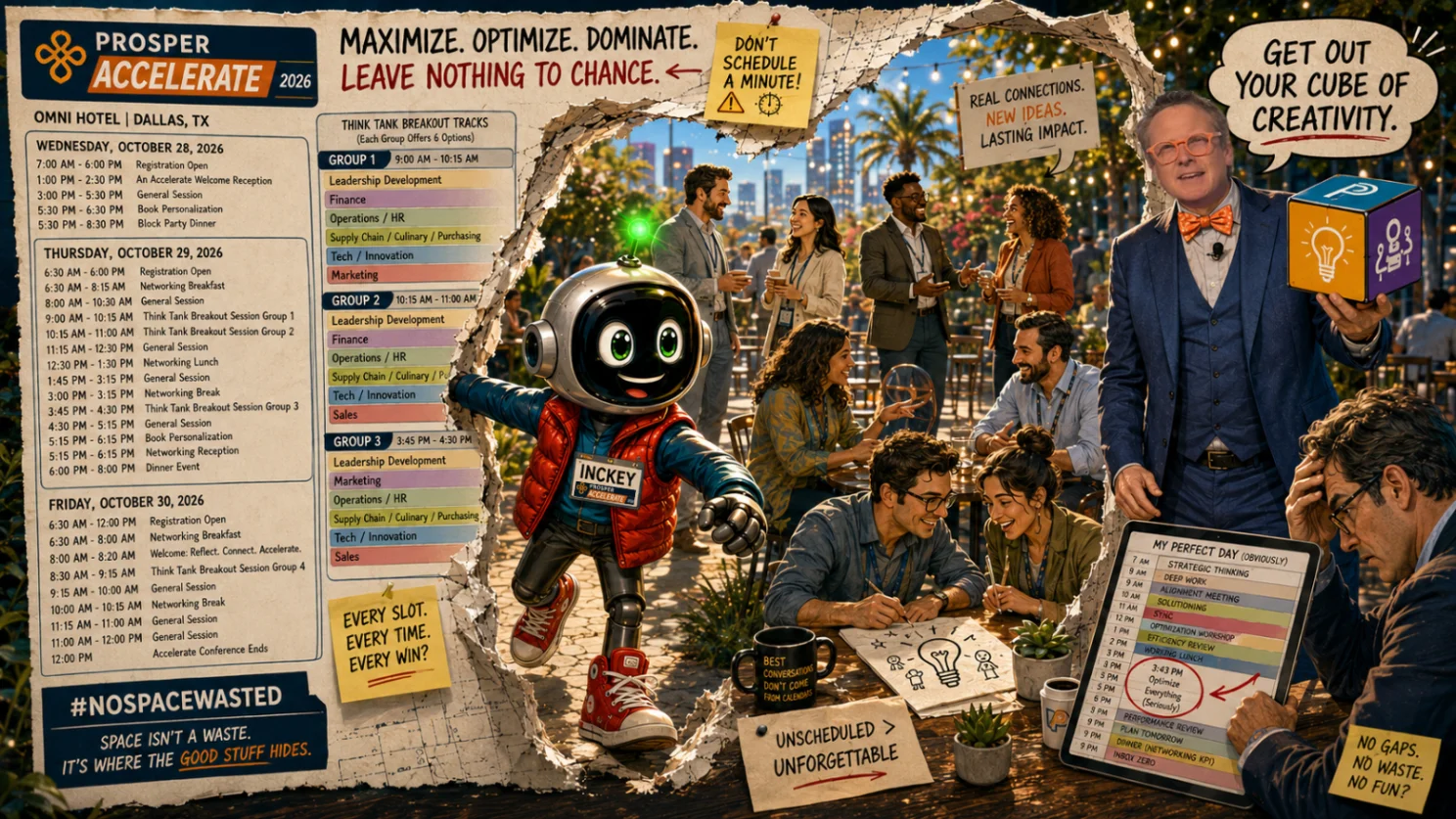
There is a temptation when an agenda has this much happening to optimize every minute like you’re coordinating air traffic over Chicago. Session here, meeting there, coffee with this person, dinner with that group, fifteen-minute opening at 3:40 and apparently no time whatsoever to behave like a human.
This year, we’re leaving some white space because we learned that some of the best parts of Accelerate happen in the gaps. We want the conversation we didn’t schedule, the person we don’t already know and the session outside our normal lanes. We want somebody to challenge an idea we walked into Dallas believing, and we want to find ourselves at dinner talking about something neither of us expected to discuss when we woke up that morning.
We also want to laugh. Business events could use more of that.
We work in restaurants and with restaurant people. This industry is filled with enormously talented humans attempting difficult things while customers, technology, economics, weather, labor, landlords and occasionally lettuce conspire to make the original plan irrelevant. If you cannot find some humor in that, you are going to have a very long career.
Last year, Chad and I went to Prosper Accelerate hoping Prosper was building something different. We came home believing they were. A year later, we’ve had the chance to work alongside their team, contribute to The Prosper Brief and spend time at the Prosper Forum talking with 17 smart people who gave us 17 different windows into where this industry is headed.
Now we get to go back to the place where this relationship started for us.
We’re excited about the speakers and the sessions, but we already know some of the best things that happen at Accelerate won’t appear anywhere on the agenda. Somewhere in that room is a conversation we don’t know we need yet, with somebody we haven’t met, about an idea neither of us brought to Dallas.
After last year, we know enough not to try to predict it. We just want to be there when it happens.
And we’d love to see some of you there with us.
If you’re part of the Inc Tank GTM or ChatGTM Podcast community and have been thinking about joining us at Prosper Accelerate, we can make the decision $250 easier. Register for Prosper Accelerate and use our community discount code IncTankAccSav250 to save $250 on your registration.
Come for the speakers and get into the conversations. Sit next to somebody you don’t know. Go to the session you normally wouldn’t choose. Leave enough room in your schedule for something unexpected to happen.
And if you see Chad and me wandering around Dallas discussing restaurants, AI, GTM strategy or some unholy combination of all three, come say hello.
There’s a reasonable chance we’ll have a microphone nearby.
Register for Prosper Accelerate: https://prosperaccelerate.com/
Inc Tank GTM + ChatGTM Podcast Community Discount: $250 off registration
Use code: IncTankAccSav250