By Michael Beck & Inckey
The Price of Admission
A few days ago I opened one of the first podcast projects we ever produced at Inc Tank, and within about thirty seconds I was asking myself the same question every creative eventually asks.
What on earth was I thinking?
Old work has a way of doing that. It doesn't yell at you. It doesn't criticize you. It just reminds you of the person who made it, and sometimes that's enough to make you close the laptop and stare out the window for a minute.
The audio wasn't terrible, but it wasn't good either. It had that unmistakable sound of people trying really hard without yet knowing what "good" actually sounded like. The lighting drifted from shot to shot because we were making adjustments based on confidence instead of competence. At the time we thought we were making cinematic decisions. Looking back, we were mostly documenting our own confusion.
Then I opened the edit.
That was the real time capsule.
I could almost reconstruct the day just by looking at the timeline. I remembered exactly where I'd gotten stuck because I'd spent hours trying to solve problems that today I could probably fix before my coffee cooled down. I'd export the wrong settings, wait for the render, discover I'd missed something obvious, export it again, and somehow convince myself this was simply what professional editing looked like. We didn't have a workflow. We had optimism and a remarkable willingness to learn everything the slow way.
Some of those early episodes sat on hard drives for months because I couldn't figure out how to finish them. A few never made it out into the world at all. Somewhere there's a forgotten folder full of interviews that sacrificed themselves so the rest of us could eventually learn what we were doing. I'd like to think they understood the assignment.
At the time, none of it felt like learning.
It felt expensive.
Every mistake felt like evidence we weren't ready. Every setback carried that familiar whisper every beginner hears eventually: Maybe you're just not very good at this.
Looking back, I think I misunderstood the entire arrangement.
Those projects weren't proof we were failing.
They were proof we'd finally started.

Experience is a strange thing because it's the one thing nobody can give you before you need it. You can't borrow it from someone who's already earned it. You can't buy enough books to replace it or watch enough YouTube videos to skip it. Experience only seems willing to arrive after you've been humbled enough to appreciate why it matters.
It's an inefficient system.
It's also the fairest one I know.
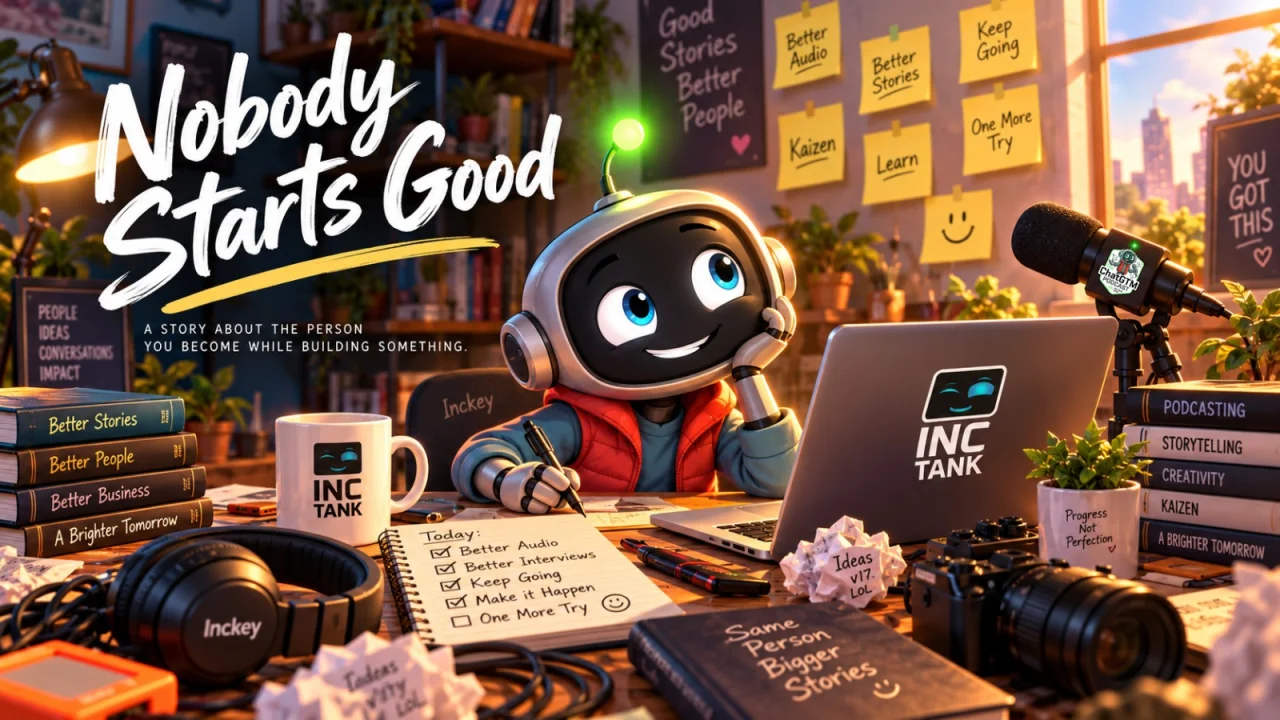
The Japanese have a philosophy called Kaizen, the practice of getting a little better every day. People often translate it as continuous improvement, but living it feels much less impressive than it sounds. Most days it doesn't feel like progress at all. It feels like finally understanding why your interviews get better when you stop thinking about your next question and actually listen to the answer. It feels like realizing your guest doesn't need another camera angle nearly as much as they need someone who makes them forget the cameras are there. It feels like solving one small problem today that the version of you six months from now won't even remember was once difficult.
Nobody notices those moments except the person living them.
That's probably why they're so easy to underestimate.
The funny thing is, those tiny, forgettable moments eventually become the entire story. They create the distance between the person who started and the person who kept going. Looking back now, I don't think the biggest thing we were building in those early days was a podcast.
We were building ourselves.
And that turned out to be a much more interesting project than I ever expected.
The Destination You Never Planned
For the longest time, I thought we were learning how to be a better go to market agency, not transforming into a media platform powered by podcasts, field reporting and professional interviews.
That's what success looked like in my head. A big consulting biz, working with tech startups and being their go to strategic advisors, sales ops, rev ops and GTM Sherpas. I figured if we just kept improving that side of the business, everything else would eventually fall into place.
In fairness, those things did matter. But what happened is we discovered how powerful media is today and such critical part of helping our clients be seen and heard we realized that things like better equipment made our work better. Better systems made us faster. Better questions made better conversations. But somewhere in the middle of all that progress, I realized I'd been paying attention to the wrong transformation.
The mission wasn't changing...
We were.
When I started Inc Tank, I could've told you exactly what business we were in.
"We're a Go To Market Agency."
It was simple. Easy to explain. Easy to understand.
Today, I wouldn't answer that question the same way.
When we started Inc Tank, we weren't podcasters. We didn't have a production background, a polished process, or years of experience to lean on. We had curiosity, a willingness to look foolish, and just enough confidence to begin before we were ready. Today, podcasting is one of the pillars of our business and always will be. It's where we learned our craft, discovered the power of authentic conversations, and realized that trust is built one story at a time. But somewhere along the way, it became clear that podcasting was never the destination. It was the doorway. It led us to build the GTM Agency and, more importantly, helped us discover that what we were really in the business of wasn't producing podcasts, it was helping businesses find their voice.
People weren't coming to us because they wanted another podcast.
They were coming to us because they had spent twenty years building something remarkable and didn't know how to tell that story. They needed help finding the thread that connected all those years of experience into something another human being could understand. Sometimes that story became a podcast. Sometimes it became short-form video, a content strategy, a keynote, or an entire media ecosystem.
The deliverable wasn't really the point.
Helping people find their voice was.
What's interesting is that I don't remember making that decision. There wasn't a meeting where we all agreed to become something different. It happened gradually, one client at a time. We'd solve one problem, only to discover the real problem was sitting right behind it. By the time we looked up, Inc Tank had become something bigger than the company we'd originally set out to build.
Around that same time, we launched The ChatGTM Podcast, and if I'm honest, I started it for a pretty selfish reason.
I wanted an excuse to sit down with people who were smarter than I was.
- Founders.
- Marketers.
- Operators.
- Creators.
People who had already solved problems I hadn't even encountered yet.
I figured if I could borrow an hour of their time every week, I'd probably leave knowing something I didn't know when I sat down.
It turned out to be one of the best business decisions I've ever made.
Not because it generated leads.
Not because it expanded our network.
Those things happened, but they weren't the real return on investment.
The real return was perspective.
Every guest challenged an assumption I didn't know I was carrying. Every conversation left me with another idea to wrestle with long after the cameras stopped rolling. Sometimes the lesson came from something they said. Sometimes it came from the way they thought. Sometimes it came from watching two successful people completely disagree with each other and realizing there are a dozen different ways to build a meaningful business.
Without realizing it, The ChatGTM Podcast became my continuing education.
For a while, I thought the podcast existed to support Inc Tank.
Looking back, I think they were shaping each other.
The conversations we had on the podcast changed the questions we asked inside the business. They changed the kinds of clients we wanted to work with. They changed how we thought about storytelling, content, marketing, and ultimately our role in helping businesses grow. Inc Tank gave the podcast a purpose, and the podcast gave Inc Tank a new direction.
I don't think that's unusual.
People love telling the stories of companies like Nintendo, YouTube, or Slack because they sound like brilliant pivots. Nintendo started with playing cards. YouTube was originally a dating website. Slack was born from a failed video game.
I don't think those companies succeeded because they pivoted.
I think they succeeded because they paid attention.
They were willing to admit reality had a better idea than the one they started with.
There's a lesson in that I've been trying to carry with me ever since.
Have a vision.
Absolutely.
Know why you're building something.
Without question.
Just don't become so attached to your original destination that you miss the one experience is trying to lead you toward.
Sometimes the best thing you build isn't the thing you planned.
Sometimes it's the person capable of recognizing where you were supposed to go all along.
Run Your Own Race
Somewhere along the way, another assumption I'd been carrying around fell apart. It had nothing to do with podcasting or media. It had everything to do with the way I looked at the people around me.
When you're building something, comparison almost feels inevitable. You see another company producing incredible work, another founder landing clients you'd love to have, another creator publishing something that makes you think, I wish I'd made that. Before long, you've turned someone else's story into the yardstick for your own, which is a strange thing to do when you think about it. We compare our Tuesday to someone else's decade. Then we act surprised when the math doesn't work.
When we started our ChatGTM Podcast, my first goal was simply not to suck. If I'm being perfectly honest, at the time, that felt like a pretty ambitious goal. Then I started paying attention to people outside our market. I found creators producing work I couldn't imagine making yet. Then I found people who were building media companies instead of production companies. Then I met entrepreneurs who weren't just creating content; they were building communities, teaching openly, and fundamentally changing the way people thought about their industries.
The farther I looked, the farther away the horizon seemed to move.
At first, that was discouraging. Eventually, it became one of the most freeing realizations I've had since starting this business. There is always another level. Always. Someone has a better studio. Someone tells better stories. Someone asks better questions. Someone has already solved a problem you're about to spend six months wrestling with. If your definition of success depends on eventually becoming the biggest or the best, you've accidentally signed up for a race that has no finish line.
Once I accepted that, I stopped worrying so much about catching people and became much more interested in learning from them. That sounds obvious now, but it was a surprisingly difficult shift because business has a funny way of teaching us to see everyone through the lens of competition. We protect ideas. We guard relationships. We convince ourselves that someone else's success must somehow come at the expense of our own.
I've never found much evidence that this is actually true.
One of the people who challenged that thinking more than anyone else for me was Shawn Walchef. Long before I knew him personally, I watched how he operated, and what struck me wasn't the quality of his podcast or the size of his audience. Plenty of people produce great content. What stood out was the generosity behind it. Shawn seemed completely uninterested in hoarding what he'd learned. He answered questions most people would've ignored. He introduced people who could help one another. He shared ideas that others might have hidden behind a consulting agreement or an online course.
His phrase, "Rising tides raise all ships," isn't something he says because it sounds good. It's simply the way he does business.
Watching that forced me to confront an assumption I didn't realize I was carrying. I'd always thought experience was something successful people protected because it gave them an advantage. Shawn behaved as though the opposite was true. He seemed to believe that sharing what he'd learned didn't diminish its value; it expanded it. The more generous he became with his knowledge, the more people trusted him. The more people trusted him, the more opportunities seemed to find him.
That changed the questions I started asking myself.
Instead of wondering how someone else had become successful, I became curious about what they'd learned along the way. Instead of looking for reasons their success didn't apply to me, I started paying attention to the habits, decisions, and philosophies that had shaped them. It turns out that's a much more productive use of your time than keeping score.
That's become one of the values I hope defines Inc Tank as we continue to grow. I don't want us to build a company that's constantly looking over its shoulder. I'd much rather build one that's known for being curious, generous, and willing to celebrate great work wherever it finds it. There will always be people ahead of us, and I hope there always are, because every person who's farther down the road is proof that the road goes farther than I can currently see.
I've started collecting teachers instead of competitors.
It's a much better way to build a business.
You Don't Build the Business First
I've been wondering lately if we've misunderstood what a business actually is.
We tend to think of it as something we build. We talk about growing the company, scaling the team, improving the systems, increasing revenue. None of those things are wrong, but they all focus on the thing we're creating instead of the person doing the creating. The longer I've been doing this, the more I think a business is simply one of life's more effective classrooms. It gives you problems you aren't equipped to solve, then waits for you to become the person who can solve them.
When I started Inc Tank, I thought I was building a company. Looking back, that's only half true. What I was really building was the person capable of leading that company, and those turned out to be two very different jobs. The cameras, the microphones, the editing software, the clients, the late nights, the mistakes, they were never just tasks on a to-do list. They were experiences slowly reshaping the way I thought, listened, communicated, and made decisions. The business wasn't simply growing alongside me. It was growing because I was.
That's one of the stranger gifts experience gives you. It doesn't just make you better at what you already know. It changes what you notice. Two years ago I was obsessed with production quality. I worried about cameras, microphones, transitions, and editing techniques because I assumed those were the things separating good work from great work. Today I still care about those things, but they're no longer where my attention naturally goes. I pay attention to whether someone feels comfortable enough to tell the truth. I notice when a founder is explaining what they do instead of why it matters. I notice when someone is trying so hard to sound like an expert that they've forgotten how interesting it is to simply sound like themselves.
None of those observations came from a course or a book. They came from repetition. They came from enough conversations, enough mistakes, and enough moments where reality gently corrected my assumptions. That's why I've become less attached to destinations than I used to be. If you'd asked me where Inc Tank would be today when we first opened our doors, I would've answered with complete confidence. I also would've been completely wrong. Not because the vision lacked ambition, but because it lacked experience. I was trying to draw a map before I'd ever walked the terrain.
I think we all do that. We make plans using the knowledge we have today, then become frustrated when life introduces opportunities that weren't on the original blueprint. The irony is that those opportunities often couldn't have existed for us earlier because we hadn't yet become the kind of people who could recognize them. Experience doesn't simply change your abilities. It changes your field of vision.
Maybe that's why I've stopped asking where all of this is going.
That question has never been especially useful because the answer keeps changing.
The more interesting question has become, Who is this work asking me to become?
That question has carried me through every stage of this journey. It was there when we were struggling through those first podcast edits. It was there when Inc Tank slowly evolved from a go to market consulting agency into a media company, that provides go to market services. It was there every time a conversation on The ChatGTM Podcast challenged an assumption I'd been carrying around for years. It was there when people like Shawn Walchef showed me that generosity isn't just a character trait, it's a philosophy capable of shaping an entire business.

When I opened those old podcast projects a few days ago, I expected to laugh at the audio and cringe at the edits. I did both. What surprised me was realizing I wasn't really looking at old work. I was meeting an earlier version of myself. He was impatient. He confused activity with progress. He believed success meant arriving somewhere instead of becoming someone. He didn't know what Inc Tank would eventually become because he couldn't have known. He still had too much to learn.
I'm grateful he started anyway.
Every once in a while I'll probably open those old projects again. Five years from now, I hope I do the same thing with the work we're creating today. I hope I notice things I'd improve. I hope I see better questions I could've asked, stronger stories I could've told, and opportunities I completely missed. Not because I want today's work to be bad, but because I want tomorrow's version of me to have grown beyond it.
If these last few years have taught me anything, it's that you never really build the business first.
You build the person.
The business simply becomes the evidence.