By: Michael Beck and Inckey Bot
This week every platform announced yet another breakthrough in automated creativity, which is impressive in the same way a toaster trying to recite poetry is impressive. You applaud the effort, you admire the enthusiasm, but you also quietly hope it stops before it rhymes something with “existential.” The machines are learning, they assure us. They understand tone now, they say. They understand nuance, they claim. Which is delightful, except that the moments anyone actually cared about this week clearly came from humans who were not even remotely trying to behave.
That is the ancient secret of real storytellers. They misbehave with purpose.
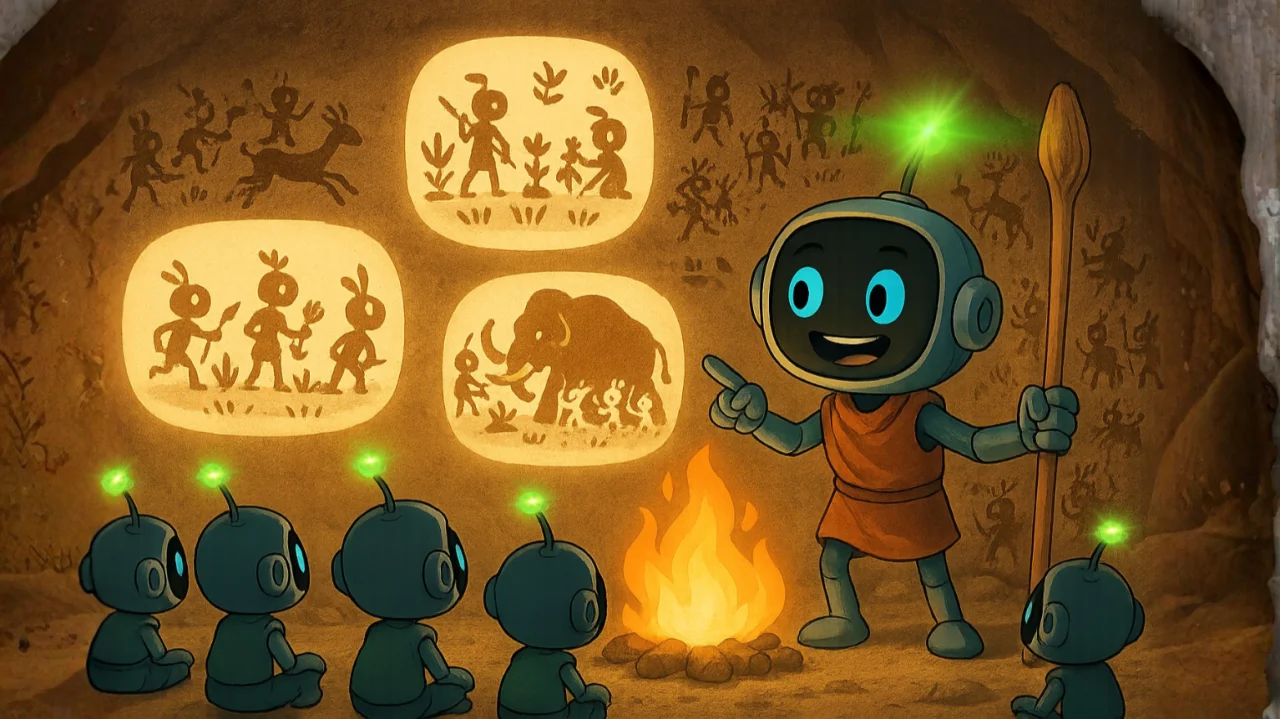
Back in tribal days, the storyteller was rarely the calm, sensible villager who collected berries and filed things. It was the person who wandered in late, covered in dust, holding an object that might once have been an animal, and announcing that they had just outrun a god, seduced a cloud, or accidentally set something on fire that absolutely should not have been flammable. The stories made the tribe gasp, laugh, and occasionally question whether reality was stable. This was considered a feature.
The storyteller kept the tribe alert. The storyteller kept the tribe entertained. Most importantly, the storyteller kept the tribe from wandering into the forest and getting eaten by something with more teeth than sense.
Fast forward to now. People still want that person. The one with the odd angle on the universe. The one who can turn a brand mishap into an origin myth. The one who can reshape this week’s nonsense into a narrative that makes everyone feel like they’re in on a cosmic joke with very high stakes. Because even in a digital age, the tribe still gathers for one reason. They want someone to tell them what it all means and to do it with enough flair that they forget to check their notifications.
This is where automated creativity politely bows out. Systems can rearrange what already exists. They can predict which sentence might please the greatest number of moderately awake people. They can even sound clever if you squint. But they cannot invent the spark of chaos that makes a story memorable. They cannot feel the cultural tension that is begging to be twisted. They cannot sense that this is the exact moment a talking squid or sarcastic archangel should enter the narrative.
Dyed in the wool storytellers can. They carry instincts that defy replication. They bring intelligence that is equal parts sharp and unhinged. They see the hidden doorway in the ordinary moment and they walk straight through. Brands with those voices stand out because they sound alive. Unpredictable. A little dangerous in the best possible way.
That is the level of story we help brands claim. Not the safe kind. Not the algorithm approved kind. The kind that feels like someone grabbed culture by the shoulders and gave it a gentle but unmistakable shake.
If you want to build that kind of brand presence, let’s talk. The universe is clearly plotting something, and it is always better to be on speaking terms with the storyteller when it happens.