By: Michael Beck
🕵️ Planning the Heist: The Making of Our Ocean’s 15
Because the house always wins. Play long enough, you never change the stakes, the house takes you. Unless, when that perfect hand comes along, you bet big, and then you take the house. - Danny Ocean
At Inc Tank GTM, we don’t build restaurant tech. We help the ones that matter go to market, fast, sharp, and ready to win.
To do that right? We needed a crew. Not a committee. A hand-picked, high-impact, radically honest dream team of advisors.
People who actually know the operators, understand the brand side, smell the BS in bad GTM strategies, and can see tech trends before they become panel topics.
So, yeah… we planned it like a heist.

🎬 Act I: The Briefcase, the Compass, and the Guy Training AI in a Fry Pit
You can’t build a modern go-to-market think tank without a few legendary origin stories and the kind of elevator meetings that turn into momentum.
So we did it like they do in the movies, with a montage and some great lo-fi music...
- Phil Crawford was sketching commerce architectures on a Chili’s napkin. His diagram made a mid-tier POS cry.
- Anthony Presley scribbled TimeForge v1.5 on a boarding pass in Row 23B. He’d already pivoted three startups by wheels down.
- 🟦 Christopher Sebes fixed a legacy POS using a paperclip, espresso grounds, and possibly ancient magic. He didn’t speak, he calibrated.
- Fred LeFranc was barefoot in the desert with a flip chart titled “Vision Without Pretension.” He accepted our offer with a single head nod and disappeared in a cloud of sage smoke.
- Kevin Bentley, MBA, MSIS, CSM, Prosci benched a linebacker and a monolithic tech stack in the same afternoon.
- Zerrick Pearson emerged from a Five Guys data center muttering, “Only scalable culture wins.” We gave him a badge on the spot.
- Cristal Craven told a boardroom their partnership model was built like a folding chair. She rebuilt it before finishing her latte.
- Geoff Alexander was running bao logistics and supply chain scenario models like a Bond villain crossed with a dim sum DJ, we found him in a test kitchen with more steam than secrets and a whiteboard labeled “Global Dumpling Domination.”
- Amy Hom ran an ops intervention like a ghost chef mid-shift, while casually doing a Vanity Fair shoot with Annie Leibovitz. By the time she left, the floor ran like a Swiss watch, and her makeup was flawless.
- Brock Weeks trained a computer vision model on fry line movement using video footage and ancient oil stains.
- Jeff Caplan handed us a legacy transformation plan on cocktail napkins and said, “This is how Hooters survived the ‘90s. You’re welcome.”
- Marcus Wasdin was in a back office fixing a thermal printer and a sales forecast. We still don’t know how he did either.
- Kendall Ware, CFE was mid-keynote, holding a franchisee audience like a rock concert. We hired him between slides.
- John MacPherson emerged from a Web3 summit wearing a QR-code hoodie. He explained tokenized loyalty like poetry. We still don’t understand half of it, but we trust him completely.
- Brandon Rhoten was located via scorched tweet threads, the Wendy’s Troll himself. We pitched him. He roasted us. We hired him anyway.
📘 Act II: The Real Reason This Matters
Yes, the story’s fun. But the strategy? Dead serious.
We don’t build products. We help hospitality tech companies go to market with conviction, clarity, and credibility.
To do that well, we need insight, not echo chambers.
We built this board using two foundational texts:
📚 Built to SCALE by Marissa Levin
“The best boards aren’t filled with friends or famous names. They’re built like investment portfolios, strategically diverse, value-aligned, and designed to multiply impact.”
Levin recommends a Core 5, with specialist advisors layered in based on business stage and focus. We built exactly that, an advisory OS, not a vanity board.
📘 Startup Boards (2nd Ed.) by Brad Feld & Matt Blumberg
“Your board can either be a cost center of time and energy, or a source of massive leverage. The difference is intentionality.”
Our board helps us decide which categories to expand into, which trends to ignore, and how to shape GTM strategy before our clients hit the real world.
🧠 Inc Tank's Ocean’s 15 Matrix
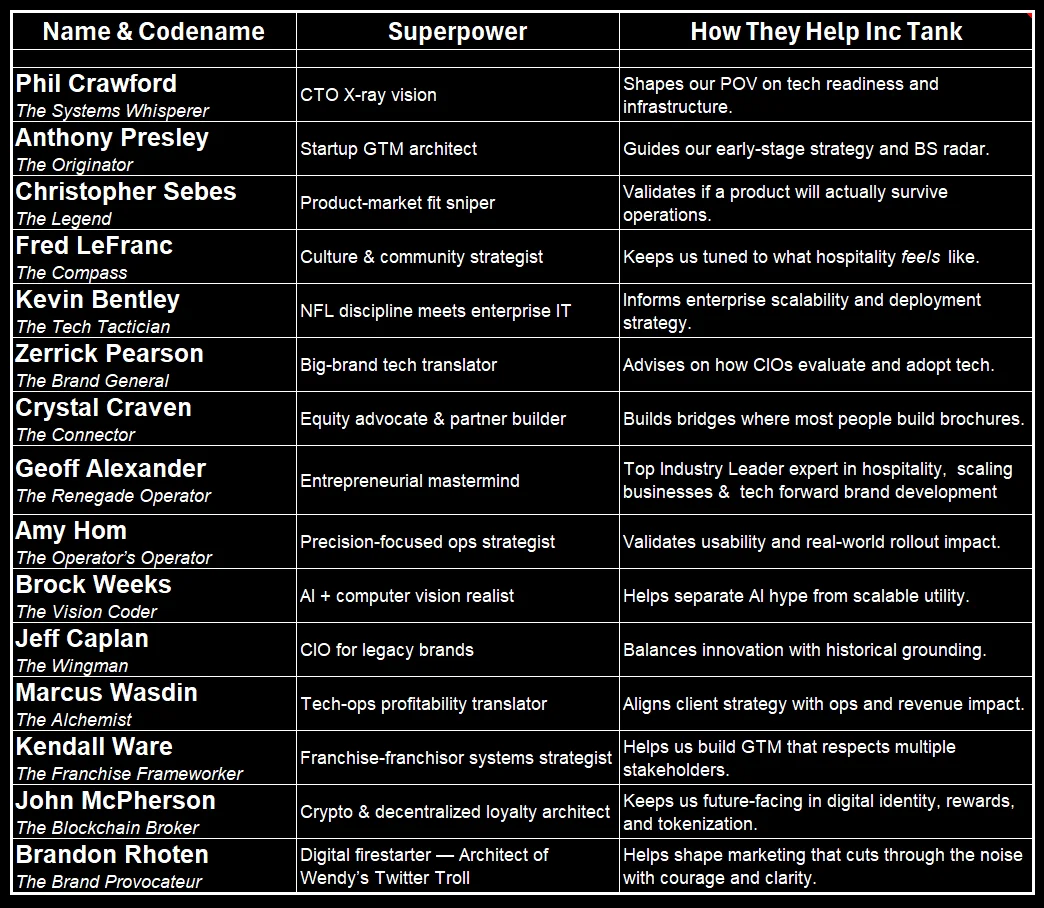
“Isn’t That... a Lot of People?”
Yes. And intentionally so.
“Five to seven advisors is ideal for a core board,” Levin writes. “But the Core 5 is not the ceiling. It’s the anchor.”
We layered in experts, not to crowd the table, but to make the table smarter. Each one unlocks a category, a conversation, or a competency.
Though admittedly during the process Jeff Caplan and I quipped that too many advisors might start looking more like a focus group than an intentional and purpose-built committee.
- 0.5x
- 0.75x
- 1x, selected
- 1.25x
- 1.5x
- 1.75x
- 2x
Media player modal window
This isn’t “too many cooks.” This is a Michelin kitchen, where each advisor plates a different course with intention.
Why so many? Because hospitality tech is part art, part war, and part cosmic improv. We’re not here to survive the chaos, we’re here to name it, dance with it, and learn from it.
Final Take
This board gives us:
- ✅ Market clarity before it trends
- ✅ Product fit checks before the first pitch
- ✅ Strategy that maps to real-world ops, brands, buyers, and behavior
They help us, so we can help you.
If you're building in hospitality tech, we don’t just bring our own ideas. We bring the people who wrote the playbooks you’re trying to follow.
🧩 Coming Soon
- 🎥 Board Reveal Teaser Video
- 🌐 Interactive Advisory Microsite
- 🔁 LinkedIn Series: “Meet the Crew. Pick the Brain.”
Until then, Be bold. Be real. And build stuff worth showing to this crew.
, Beck